New Manager Boot Camp
Master How to Align, Prioritize, and Solve Complex Problems



Overview
Taking on a new or expanded role as a manager brings great rewards, but it also introduces new challenges. To be impactful in your management position requires new management training that develops your ability to lead a productive team and grows your management skills, such as adaptive leadership and productive team conflict resolution.
The New Manager Boot Camp program addresses your unique needs in your management role and empowers you to master your personal leadership style. Become a more confident manager with management skills training designed to uncover your management strengths. Effective leadership is grounded in your understanding of powerful interpersonal skills that inspire performance, communication, employee retention, and motivation to achieve goals.

More about the New Manager Boot Camp program
Managerial success starts with understanding yourself and your team. All new managers face similar challenges when they step into their roles. Without the proper guidance, these challenges can be overwhelming and impact your team’s productivity. Through leadership & management training, you can avoid the stress involved in figuring out your management role on your own and become a more effective leader much faster.
Our New Manager Boot Camp equips you with the current research and best practices to assess and improve your management style to better serve your team and organization. In this training for new managers, you will improve your essential management skills that will advance business agility, equip you with the tools to manage complex change, and adapt your leadership styles to fit your team’s unique needs to drive performance and productivity.
Become a More Effective Manager
Uncover the secrets to time management at the workplace, analyze how different management styles influence outcomes of team performance, apply teamwork to manage complex change, effectively manage time and delegate tasks enabling you to prioritize.
Enjoy an Engaging Program Experience
This highly recommended new manager training course is led by esteemed Berkeley Haas faculty with expertise focused on elevating your leadership skills. Through a dynamic classroom experience, you will:
- Develop a personal, ready-to-implement action plan
- Engage with speakers from companies like Cisco Systems, Microsoft and Amgen talk about their personal experiences as new managers, lessons learned and tips for success
- Participate in exclusive networking opportunities
Pre-work: Hit the Ground Running
To fully prepare for the program, participants must complete seven pre-readings and two assessments—an adaptive skills assessment and a leadership style questionnaire. The leadership style questionnaire requires input from colleagues and will provide valuable insights into your strengths and areas for growth in both your leadership approach and adaptive abilities.
To maximize your program experience, we recommend registering and paying at least 40 days before the class start date. Participants will receive instructions on how to complete the assessments four–five weeks before the program begins.
Results of your assessments will be discussed in detail with faculty during the program sessions. To receive printed copies for use during the program, please aim to complete them at least two weeks in advance.
Who's it for
- Business professionals considering a management role and managers that have recently moved into a supervisory position and need to develop management skills for new managers
- Engineers or professionals working in the tech space who need management training
- Executives looking to level up their management skills across multiple industries, including high tech
Want to approach your employer about professional development classes and request employer support? Read the Employer Payment Assistance Guide.
Format & Structure
In-Person
- Three-day in-person, leadership training at UC Berkeley Haas School of Business campus
- Speakers from companies like Cisco Systems, Microsoft and Amgen talk about their personal experiences as new managers, lessons learned and tips for success
- Pre-program leadership and adaptability assessments
- World-renowned Berkeley Haas and Executive Education faculty
- Collaborative learning experience
- Exclusive networking reception with faculty and peers
- Access to the program alumni community
- New Manager Boot Camp Certificate of Completion
We recommend registering at least 2-3 weeks before the program start date due to pre-work assignments.
Program experience may be affected if you enroll after the recommended date. Please note: seating is limited and capacity may be reached prior to recommended registration date.
Virtual Program Orientation: November 19 at 9:00 am PST
Dates & Costs
In-Person
Other Ways to Participate
Attend this program with a group of your colleagues.
Attend this program with colleagues to gain greater organizational impact. Groups of five or more receive special rates.
Customize this program for your organization.
Use this program's curriculum as the foundation of a program based on your company's unique objectives.
What people are saying
Get more information

Download the New Manager Boot Camp Program Guide
The complimentary guide includes sample schedule, program curriculum, learning objectives, and more.

Employer Reimbursement
Gain tips on how to approach your manager about professional development and tuition reimbursement.
How do I enroll in the New Manager Boot Camp program?
Enrolling in any one of our programs is simple:
- Click on the "enroll" button on the program page
- Create an account or log in to our customer portal
- Complete the online reservation form (should take less than 2 minutes)
- Pay by credit card to complete your enrollment, or select your preferred payment type to reserve your seat and connect with the finance team
How much time can I expect to spend on coursework each day?
We know that time away from the office is precious, so we work hard to make our program experiences as productive and valuable as possible. Our programs span full business days starting between 8:30-9:00 a.m. and running through 5 p.m. with lunch served in the classroom and short breaks throughout the day.
Approximately 1-2 hours of evening activities and preparation for the next day are required for some programs. Please download the program guide for more detail.
Do your programs provide credits towards a degree, grades, transcripts, or Continuing Education Units (CEUs)?
Our programs are non-degree programs and do not hold any credit unit equivalency, letter grades, pass/fail designation, Continuing Education Units (CEUs), or transcripts. Rather, we provide a certificate of completion at the conclusion of the program.
To qualify for a certificate of completion, a participant must meet the minimum requirements as noted for each program and maintaining at least 80% attendance/engagement.
Can I enroll in a program if I live outside of the U.S.?
Yes. Enrollment is available to global leaders, but visa requirements may apply. Proficiency in written and spoken English at a level that allows full engagement and participation in a program is recommended.
For most international participants, a B1/B2 visa—for participation in scientific, educational, professional, or business conventions, conferences, or seminars—is required for entry into the United States to attend a program with us.
Requesting and receiving a visa takes time and we recommend beginning the process three or four months in advance of the start date of a program.
You can ask your Program Manager to prepare an invitation letter to help with your visa application. It is important to emphasize that the visit is for business purposes.
The Visa Waiver Program is available to citizens or nationals from select countries. Check the Department of State website to determine your eligibility and learn about the waiver process.
The list of countries sanctioned by the Treasury Department's Office of Foreign Asset Control currently includes: Cuba, Iran, North Korea, Syria and the Ukraine-Crimea Region, plus the addition of Russia for Berkeley Executive Education at this time.
Faculty

Homa Bahrami
Senior Lecturer, Executive Teaching Fellow, Entrepreneurship & Innovation | Management of Organizations, Haas School of Business

Alex Budak
Lecturer | Executive Director, Berkeley Haas Global Access Program | Management of Organizations, Haas School of Business

Jennifer Chatman
Bank of America Dean | Co-Director, Berkeley Center for Workplace Culture and Innovation, Management of Organizations, Haas School of Business

Cort Worthington
Distinguished Teaching Fellow | Persuasive Communication & Interpersonal Dynamics, Haas School of Business
Certificates
Certificate of Completion
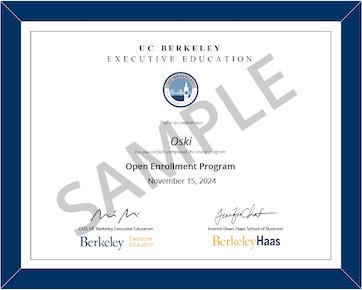
Signal your professional achievement to your network and get recognized for your completion! Upon successful completion of the program, UC Berkeley Executive Education grants a verified digital certificate of completion to participants that you are encouraged to add to your profiles.
Note: This program results in a digital certificate of completion and is not eligible for degree credit/CEUs. After successful completion of the program, your verified digital certificate will be emailed to you directly. All certificate images are for illustrative purposes only and may be subject to change at the discretion of UC Berkeley Executive Education.
Certificate of Business Excellence
Participants in the Certificate of Business Excellence (COBE) program will earn a mark of distinction from a world-class university, gain access to a powerful global network, and enjoy the flexibility of completing the program in up to three years. A UC Berkeley Certificate of Business Excellence allows individuals to create a personal learning journey structured by our four academic pillars to gain management essentials in Leadership, Entrepreneurship, Strategy, and Finance to drive both personal and organizational development.