Product Management Program
Translate Opportunities into Profitability



Overview
The Product Management program empowers product leaders to drive strategic vision, innovation, and customer-centered growth, through cutting-edge frameworks, hands-on exercises, and a world-class learning community.
Our globally recognized, in-person product management training combines the latest in customer-focused design with the best of the Berkeley-Haas MBA program. You will leave equipped to excel at your role: understanding your customers’ environment and needs, designing transformative customer experiences, innovating your business model, elevating your team’s performance, and mobilizing your organization to take action.
The program starts with a flexible, self-paced six-week online module where you will engage with custom video lectures, readings, and interactive discussions. Pre-work activities include surveys, exercises, and a simulation game.
Join us to elevate your product management skills and transform into a more inspiring and effective product leader.
Key Takeaways

Transcend Day-to-Day Firefighting and Drive Product Strategy
Harness the latest customer-centric and product manager frameworks to gain deeper insights, integrate market feedback to drive innovation, and build differentiated products and services—without succumbing to the “tyranny of the inbox.”

Master Business Model Communication
Hone your negotiation skills and learn to rapidly & effectively communicate a comprehensive business model for your existing business, as well as product extensions and new lines of business you wish to create and implement.

Optimize Management Capabilities and Profitability
Learn how to create new pricing tools and allocate scarce resources among products to optimize product line profitability, as well as effectively manage your cross-functional team (even in remote settings or when you lack direct authority).
More about the Product Management program
Strong product management is critical for any organization that wants to translate opportunities into tangible results and increase profitability. To this point, revenue growth for companies large and small often depends on solid product managers.
Those in charge of products must be able to recognize product opportunities, convincingly communicate their transformational ideas, and then turn them into profitable revenue streams. Great product managers can significantly impact an organization by optimizing products and product lines, improving management capabilities, and speaking the language of senior executives. These and other essential PM skills are what you will learn in our Product Management Training.
Enjoy An Engaging Program Experience
Over the course of five days at the Berkely-Haas campus, Dr. Sara Beckman and other preeminent program faculty lead participants through a dynamic and immersive training experience that includes:
- illuminating case studies
- lively discussions
- pragmatic hands-on exercises
Peer feedback and opportunities for personal coaching with leading product management experts are also made available to participants.
Dr. Beckman, who has led the program since 2006, continually updates the product management certification program to reflect the latest research and industry best practices. Along with all program faculty, she maintains a consulting practice, to stay up-to-date on current issues facing product managers and companies like yours.
Leverage AI to Enhance Your Team’s Productivity
Throughout the program, you’ll engage in hands-on exercises using AI tools for practical applications for product managers. Examples include brainstorming, journey mapping, storytelling, competitive analysis, survey design, interview guides, and more.
Pre-work: Hit the Ground Running
While your online pre-work is self-paced, and can be structured as your personal schedule demands, we recommend you set aside at least two hours per week to help provide the best in-program experience.
Master the Product Management Canvas and Emerge as a Powerhouse PM
Participants of this popular product manager training experience a one-of-a-kind educational experience led by world-class professors and practitioners on the cutting edge of design thinking, customer-focused design, competitive strategy, business model generation, influence without authority, team management, pricing, and customer insights.
Regarded by many as the best product management course in the business world, the training leverages the Product Management Canvas as the primary framework to help participants master product management and prepare to tackle challenges with innovative solutions and a toolset for success.
Who's it for
- Product Managers, experienced executives, and other professionals focused on product design, product development, and product launching across industries.
- A group of colleagues or team who would like to advance their skills together; ideal for cross-functional and cross-regional groups or teams.
Not a product manager? Contact us for a personal consultation to see how you can leverage the program learnings for your professional goals.
Format & Structure
In-Person
- Five-day in-person program at UC Berkeley Haas School of Business campus
- A flexible, self-paced six-week online module—set aside at least two hours per week for this
- Pre-work activities include customized video lectures, readings, interactive discussions with your classmates, surveys, exercises, and a simulation game
- World-renowned Berkeley Haas and Executive Education faculty
- Practical applications of AI tools to enhance the productivity of product managers
- Training from industry experts in design thinking, customer-focused design & insights, competitive strategy, business model generation, influence without authority, team management, and pricing
- Organization-specific innovation capabilities report
- Hands-on exercises and simulations to ensure that knowledge gets put to work in your organization
- Peer coaching from industry experts that have complementary backgrounds to yours
- Exclusive networking reception with faculty
- Access to the program alumni community
- Product Management Certificate of Completion
Program sessions are held Monday–Friday from 8:00 am–5:30 pm PT
Dates & Costs
In-Person
Register and pay by the early registration deadline to save 10% on the regular program price. Multiple discounts are not allowed and discounts may not be combined with other promotions or special offers. Visit our Support Center for more information.
Early Registration Deadlines
- September Program: August 22, 2025
- December Program: November 8, 2025
- April 2026 Program: March 8, 2026
Other Ways to Participate
Attend this program with a group of your colleagues.
Attend this program with colleagues to gain greater organizational impact. Groups of five or more receive special rates.
Customize this program for your organization.
Use this program's curriculum as the foundation of a program based on your company's unique objectives.
What people are saying
Get more information

Download the Product Management Program Guide
The complimentary guide includes sample schedule, program curriculum, learning objectives, and more.

Employer Reimbursement
Gain tips on how to approach your manager about professional development and tuition reimbursement.
How do I enroll in the Product Management program?
Enrolling in any one of our programs is simple:
- Click on the "enroll" button on the program page
- Create an account or log in to our customer portal
- Complete the online reservation form (should take less than 2 minutes)
- Pay by credit card to complete your enrollment, or select your preferred payment type to reserve your seat and connect with the finance team
How much time can I expect to spend on coursework each day?
We know that time away from the office is precious, so we work hard to make our program experiences as productive and valuable as possible. Our programs span full business days starting between 8:30-9:00 a.m. and running through 5 p.m. with lunch served in the classroom and short breaks throughout the day.
Approximately 1-2 hours of evening activities and preparation for the next day are required for some programs. Please download the program guide for more detail.
Do your programs provide credits towards a degree, grades, transcripts, or Continuing Education Units (CEUs)?
Our programs are non-degree programs and do not hold any credit unit equivalency, letter grades, pass/fail designation, Continuing Education Units (CEUs), or transcripts. Rather, we provide a certificate of completion at the conclusion of the program.
To qualify for a certificate of completion, a participant must meet the minimum requirements as noted for each program and maintaining at least 80% attendance/engagement.
Can I enroll in a program if I live outside of the U.S.?
Yes. Enrollment is available to global leaders, but visa requirements may apply. Proficiency in written and spoken English at a level that allows full engagement and participation in a program is recommended.
For most international participants, a B1/B2 visa—for participation in scientific, educational, professional, or business conventions, conferences, or seminars—is required for entry into the United States to attend a program with us.
Requesting and receiving a visa takes time and we recommend beginning the process three or four months in advance of the start date of a program.
You can ask your Program Manager to prepare an invitation letter to help with your visa application. It is important to emphasize that the visit is for business purposes.
The Visa Waiver Program is available to citizens or nationals from select countries. Check the Department of State website to determine your eligibility and learn about the waiver process.
The list of countries sanctioned by the Treasury Department's Office of Foreign Asset Control currently includes: Cuba, Iran, North Korea, Syria and the Ukraine-Crimea Region, plus the addition of Russia for Berkeley Executive Education at this time.
Faculty

Sara Beckman
Teaching Professor | Earl F. Cheit Faculty Fellow Entrepreneurship & Innovation | Innovation & Design | Operations & IT Management | Sustainability, Haas School of Business


Holly Schroth
Senior Lecturer | Distinguished Teaching Fellow | Management of Organizations


David Riemer
Executive in Residence, Lecturer | Entrepreneurship & Innovation, Haas School of Business

Certificates
Certificate of Completion
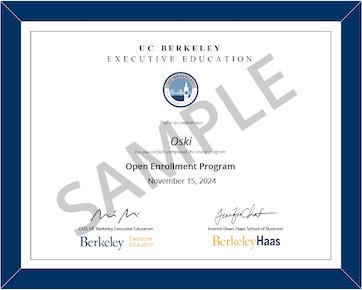
Signal your professional achievement to your network and get recognized for your completion! Upon successful completion of the program, UC Berkeley Executive Education grants a verified digital certificate of completion to participants that you are encouraged to add to your profiles.
Note: This program results in a digital certificate of completion and is not eligible for degree credit/CEUs. After successful completion of the program, your verified digital certificate will be emailed to you directly. All certificate images are for illustrative purposes only and may be subject to change at the discretion of UC Berkeley Executive Education.
Certificate of Business Excellence
Participants in the Certificate of Business Excellence (COBE) program will earn a mark of distinction from a world-class university, gain access to a powerful global network, and enjoy the flexibility of completing the program in up to three years. A UC Berkeley Certificate of Business Excellence allows individuals to create a personal learning journey structured by our four academic pillars to gain management essentials in Leadership, Entrepreneurship, Strategy, and Finance to drive both personal and organizational development.